mirror of
https://github.com/freeCodeCamp/freeCodeCamp.git
synced 2026-06-22 21:08:12 +08:00

1.4 KiB
1.4 KiB
| id | title | challengeType | forumTopicId | dashedName |
|---|---|---|---|---|
| 5900f4761000cf542c50ff88 | Problem 265: Binary Circles | 1 | 301914 | problem-265-binary-circles |
--description--
2^N binary digits can be placed in a circle so that all the $N$-digit clockwise subsequences are distinct.
For N = 3, two such circular arrangements are possible, ignoring rotations:
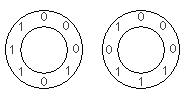
For the first arrangement, the 3-digit subsequences, in clockwise order, are: 000, 001, 010, 101, 011, 111, 110 and 100.
Each circular arrangement can be encoded as a number by concatenating the binary digits starting with the subsequence of all zeros as the most significant bits and proceeding clockwise. The two arrangements for N = 3 are thus represented as 23 and 29:
{00010111}_2 = 23\\\\
{00011101}_2 = 29$$

Calling $S(N)$ the sum of the unique numeric representations, we can see that $S(3) = 23 + 29 = 52$.

Find $S(5)$.

# --hints--

`binaryCircles()` should return `209110240768`.

```js
assert.strictEqual(binaryCircles(), 209110240768);
```

# --seed--

## --seed-contents--

```js
function binaryCircles() {

  return true;
}

binaryCircles();
```

# --solutions--

```js
// solution required
```