 2f719903b1
Some checks failed
all-good: Did all the other checks pass? / all-good (push) Has been cancelled
Ensure Prisma migrations are in sync with the schema / check_prisma_migrations (22.x) (push) Has been cancelled
DB migration compat / Check if migrations changed (push) Has been cancelled
Docker Server Build and Push / Docker Build and Push Server (push) Has been cancelled
Docker Server Build and Run / docker (push) Has been cancelled
Runs E2E API Tests (Local Emulator) / E2E Tests (Local Emulator, Node ${{ matrix.node-version }}) (22.x) (push) Has been cancelled
Runs E2E API Tests / E2E Tests (Node ${{ matrix.node-version }}, Freestyle ${{ matrix.freestyle-mode }}) (mock, 22.x) (push) Has been cancelled
Runs E2E API Tests / E2E Tests (Node ${{ matrix.node-version }}, Freestyle ${{ matrix.freestyle-mode }}) (prod, 22.x) (push) Has been cancelled
Runs E2E API Tests with custom port prefix / build (22.x) (push) Has been cancelled
Runs E2E Fallback Tests / E2E Fallback Tests (Node ${{ matrix.node-version }}) (22.x) (push) Has been cancelled
Lint & build / lint_and_build (24) (push) Has been cancelled
TOC Generator / TOC Generator (push) Has been cancelled
DB migration compat / Back-compat — Current branch migrations with ${{ needs.check-migrations-changed.outputs.base_branch }} branch code (push) Has been cancelled
DB migration compat / Forward-compat — Current branch code with ${{ needs.check-migrations-changed.outputs.base_branch }} branch migrations (push) Has been cancelled
DB migration compat / No migration changes (skipped) (push) Has been cancelled
## Summary Rewrites the **Email Server** section of the project email settings page and the managed-domain setup flow. Replaces the dropdown + conditional-fields layout with a visual four-card picker, a clearer unsaved-state model, a stepper dialog for managed-domain onboarding, and a consistent tracked-domains list. Also fixes two data-correctness bugs in the managed-domain backend. ## Walkthrough (2×, dead-frames trimmed) 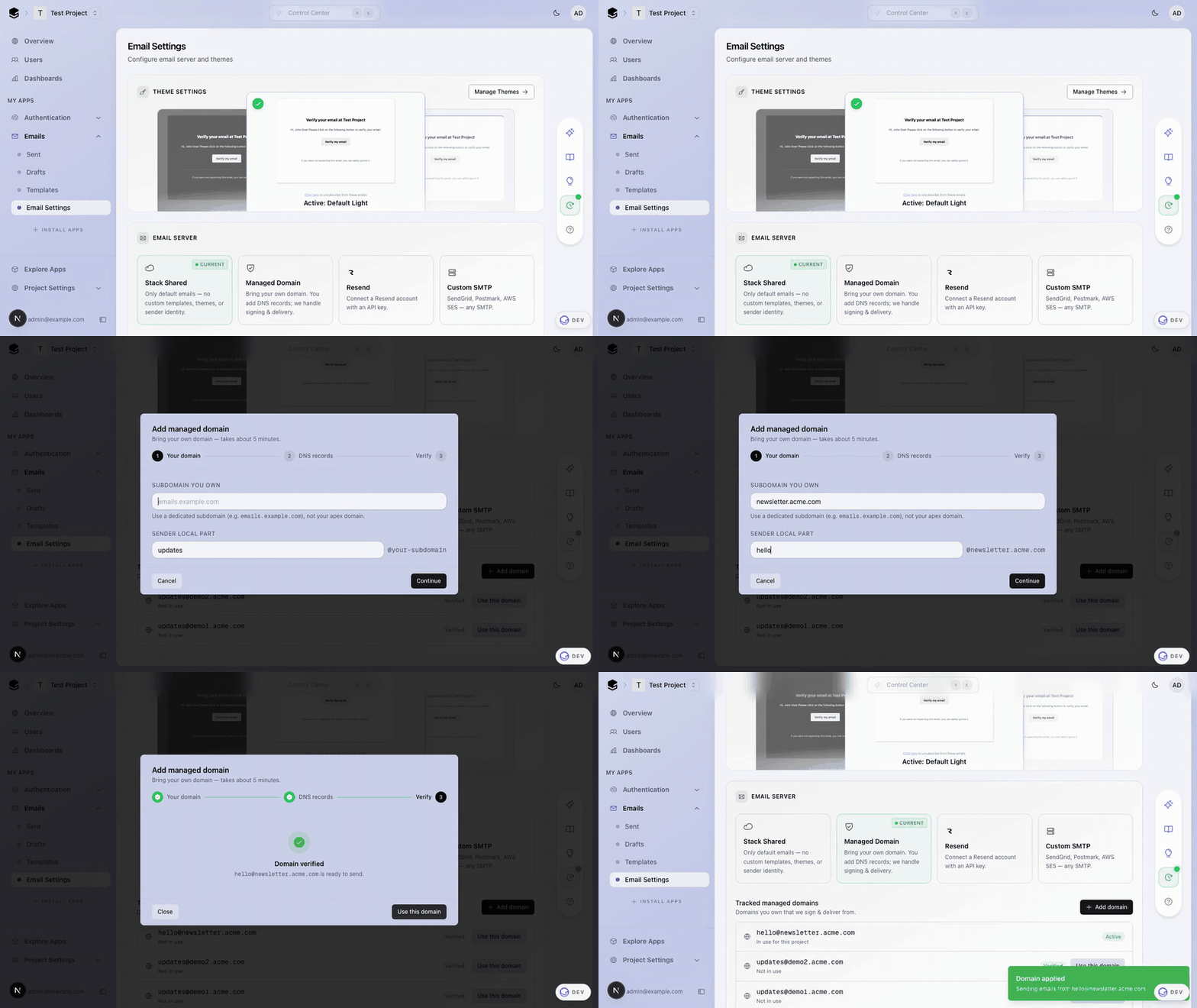 ## Before The saved state was a minimal dropdown, but choosing Custom SMTP / Resend revealed a long conditional form with a hidden gear toggle for server config, no clear "what is saved" signal, and a separate dialog pattern for managed domains. | Saved (Managed) | Custom SMTP selected | |---|---| | 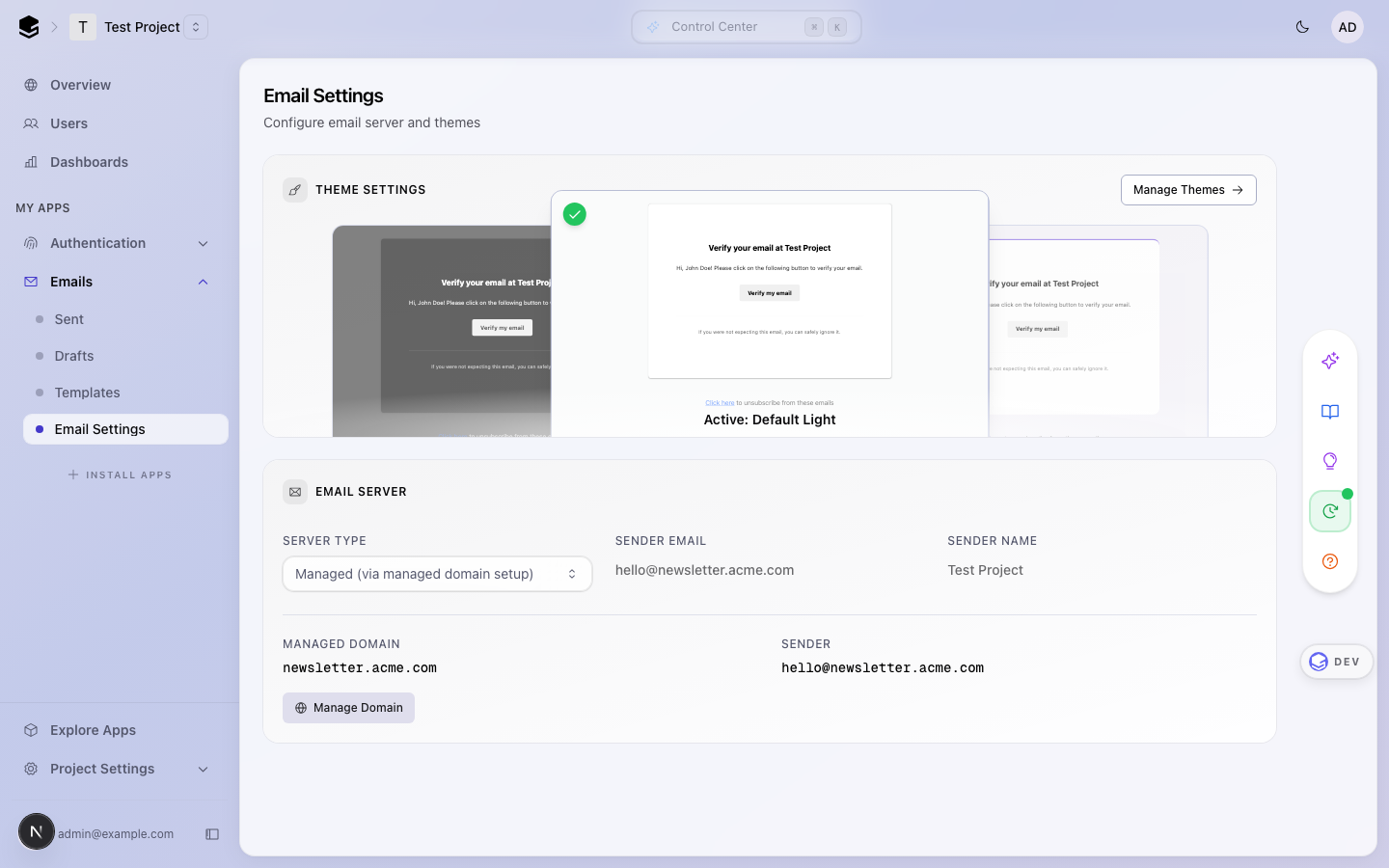 | 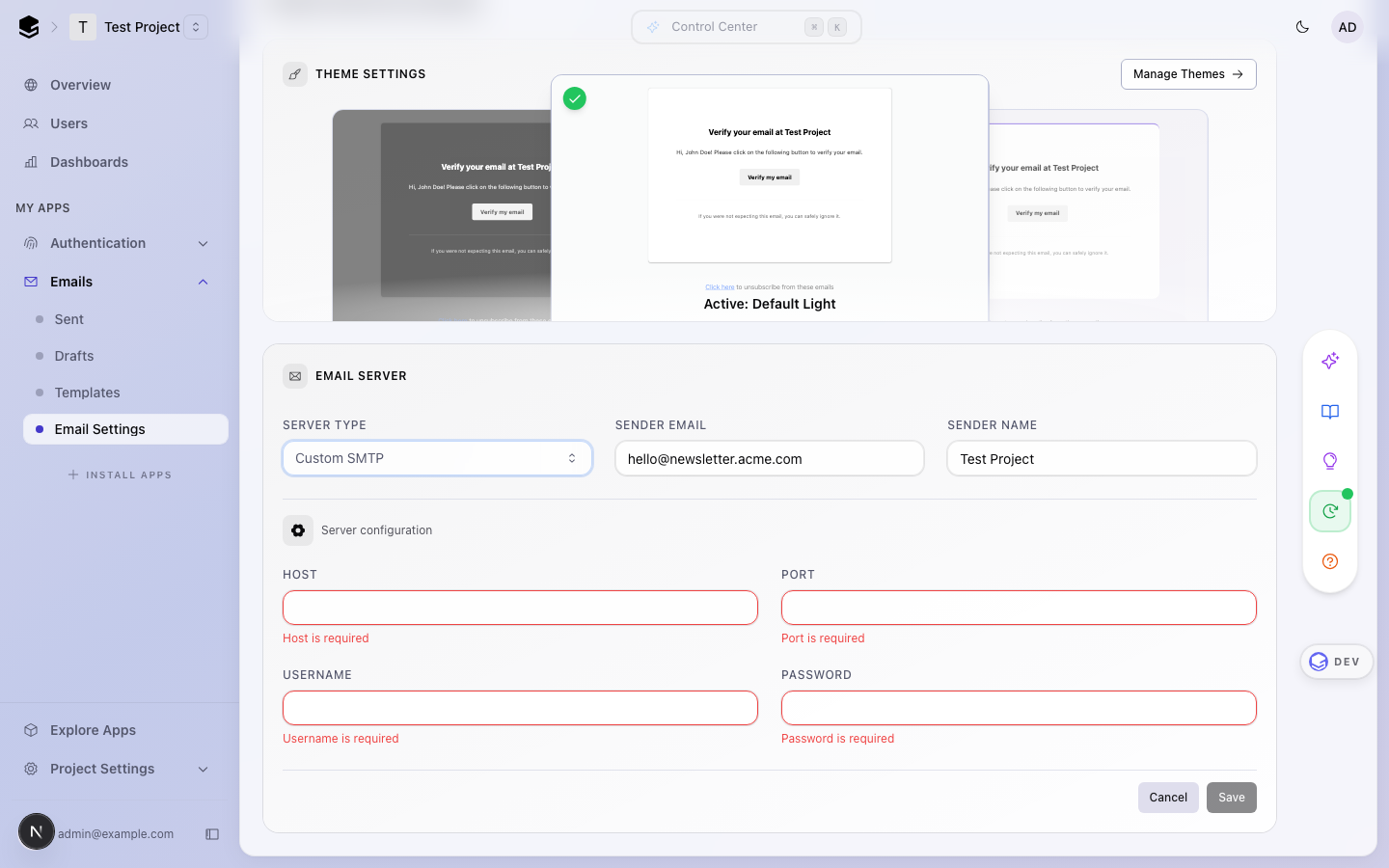 | ## After — Provider cards Four visual cards (Stack Shared, Managed Domain, Resend, Custom SMTP) with updated copy. The saved provider shows a green **Current** pill; the card the user is previewing shows an amber dashed **Draft** pill. An amber unsaved-changes banner appears between the picker and the form when state diverges from saved, so it is unambiguous that a click is not yet committed. | Saved state | Previewing a different provider | |---|---| | 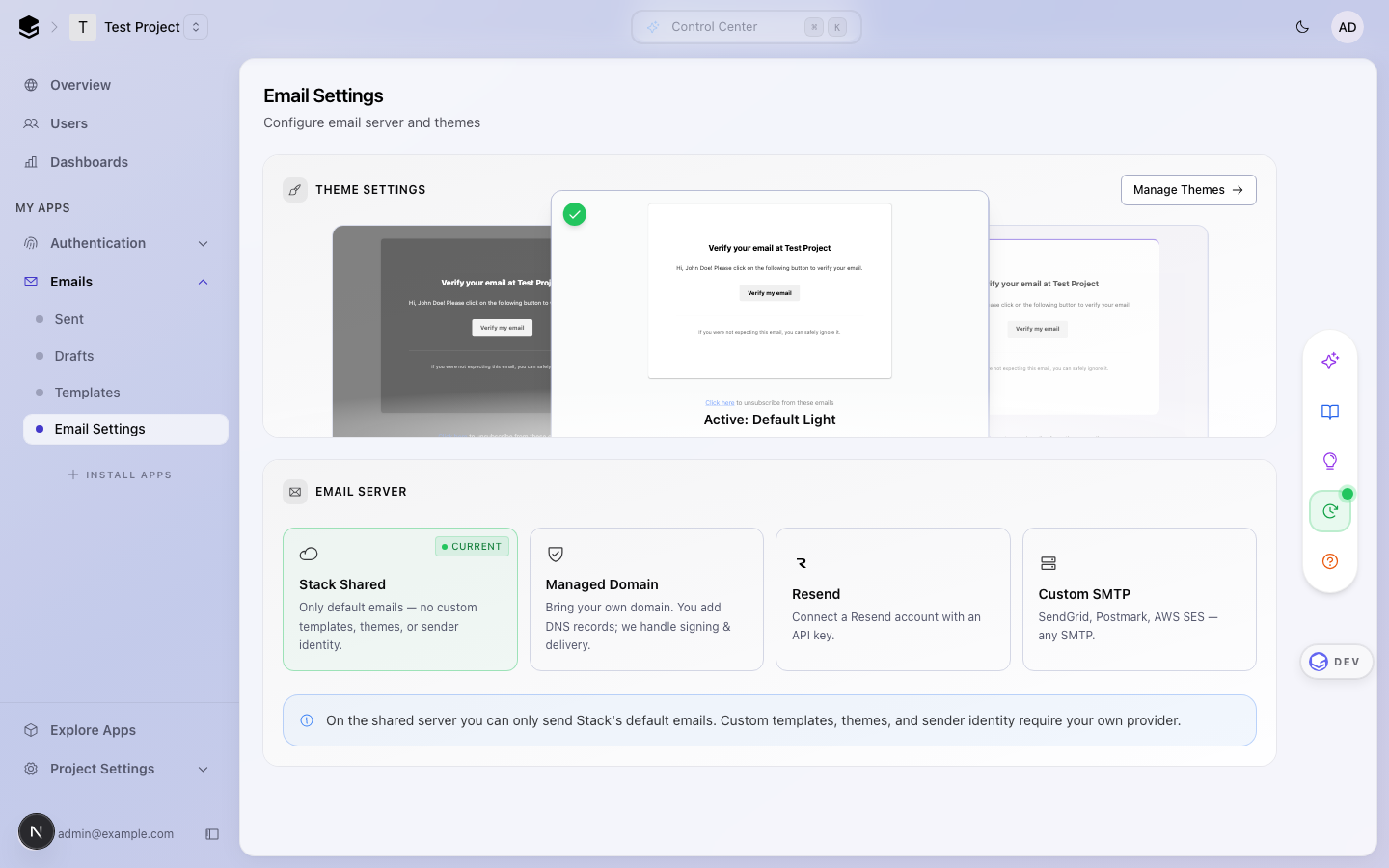 | 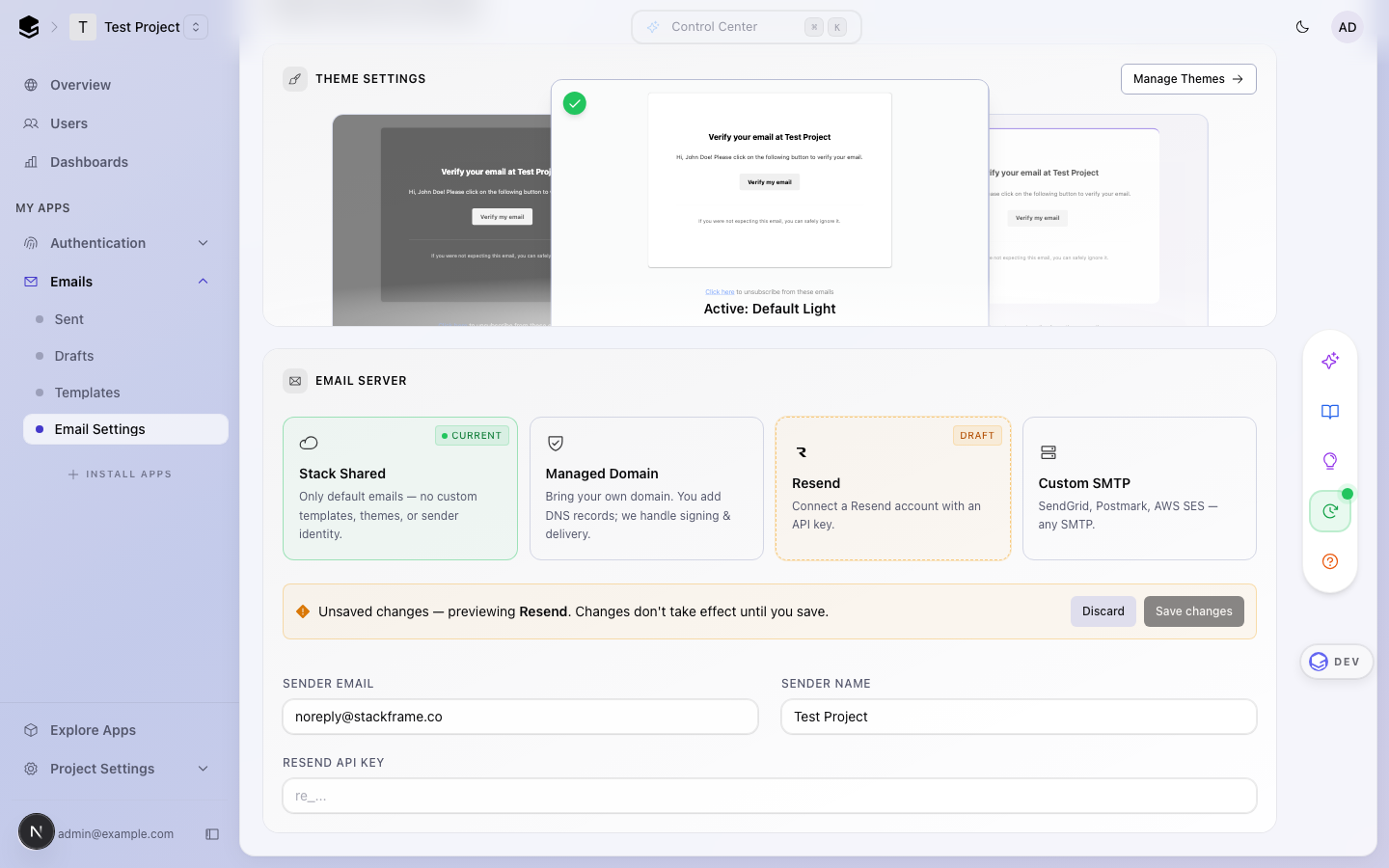 | Copy changes: - **Stack Shared** — "Only default emails — no custom templates, themes, or sender identity." (was: "Shared (noreply@stackframe.co)") - **Managed Domain** — "Bring your own domain. You add DNS records; we handle signing & delivery." (was: "Managed (via managed domain setup)") - **Resend** uses the official Resend brand mark (light/dark variants in `apps/dashboard/public/assets/`) ## After — Managed domain list + stepper dialog Selecting **Managed Domain** immediately shows the tracked-domain list with an **Add domain** button. Each row reflects real status (Active / Verified / Waiting for DNS / Verifying / Failed). Exactly one domain can be **Active** — the one matching the saved email config; every other verified/applied domain shows a **Use this domain** button so switching is always possible. Adding a domain opens a 3-stage dialog with a horizontal stepper (Verify is right-aligned for the final step). Stage 2 replaces the old bare NS-list with a proper **Type / Name / Content** DNS records table with per-row copy buttons. | Tracked domains list | DNS records table | |---|---| | 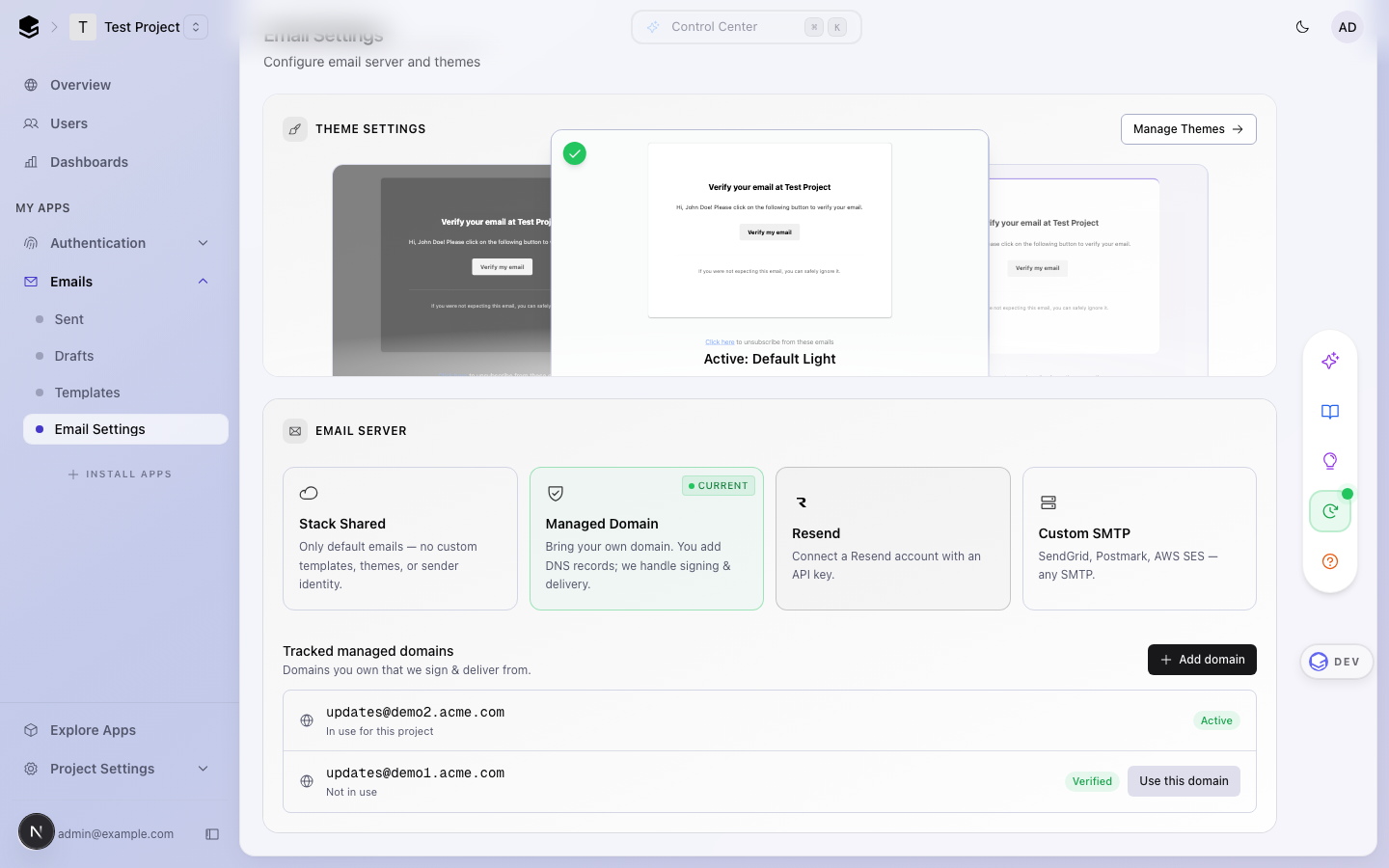 | 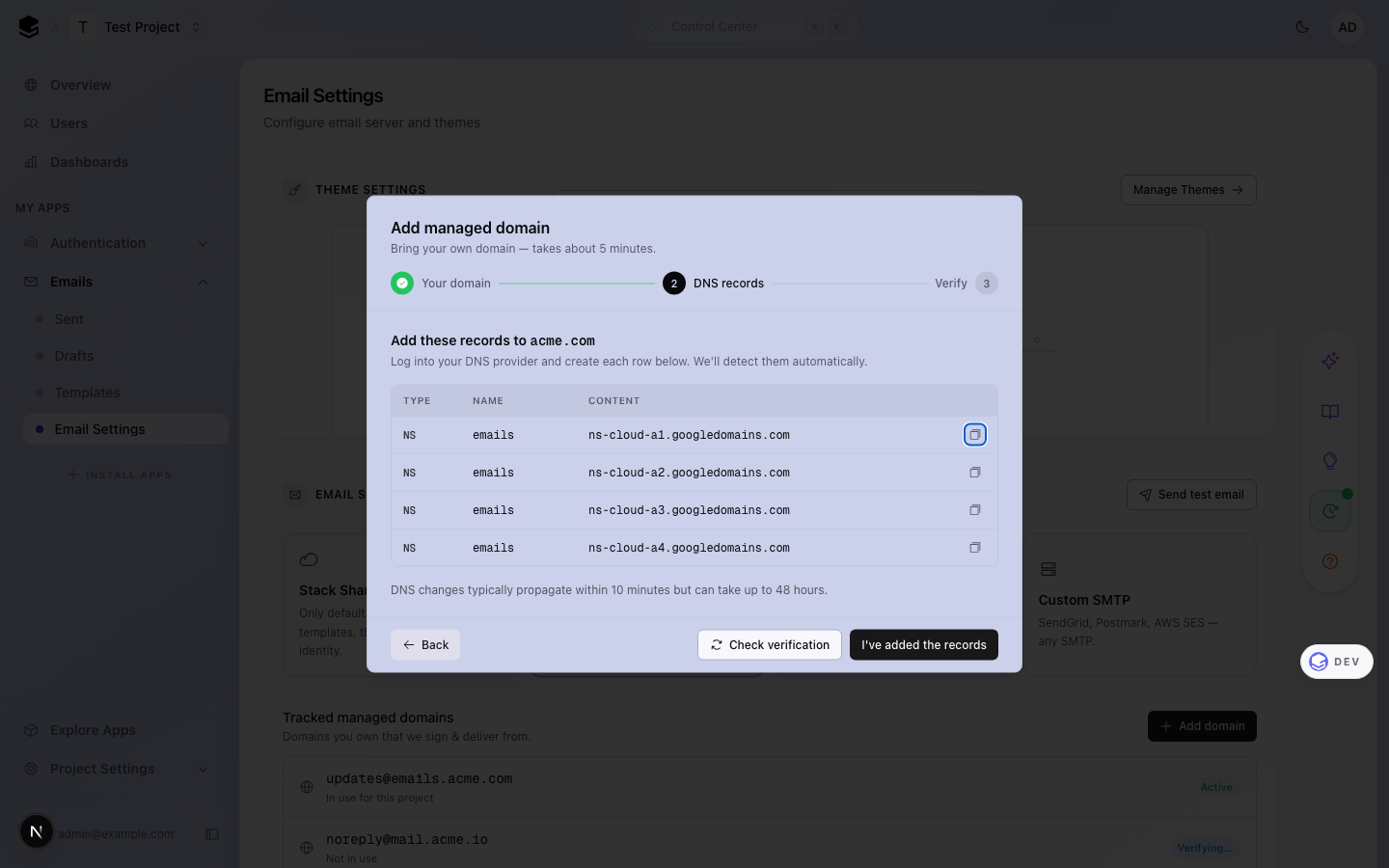 | ## Bug fixes - **Backend: applying a managed domain did not demote previously-applied ones.** Multiple rows could end up with status `APPLIED` even though only one could be in the saved config. New helper `demoteOtherAppliedManagedEmailDomains({ tenancyId, keepId })` runs inside `applyManagedEmailProvider` to demote all other applied rows in the tenancy back to `VERIFIED` before marking the new one. - **Frontend: "Use this domain" only appeared for `status === verified`.** A domain that had been applied then replaced could never be re-applied from the UI. Button now appears for any `verified` or `applied` row that is not currently in use; the **Active** label is derived from config match instead of DB status. - **Dev mock onboarding now mirrors production timing.** `shouldUseMockManagedEmailOnboarding()` used to insert domains as `verified` synchronously. Now the domain is created as `pending_verification`, and a fire-and-forget `runAsynchronously(() => wait(1000))` updates it to `verified` — mirroring the real Resend webhook flow so the UI states (pending → verifying → verified) are exercised in local dev. ## Test plan - [ ] Cards: clicking each card shows `Draft` pill + amber banner; Discard restores; Save commits and flips `Current` to the new card - [ ] Managed: Add domain → stage 1 input → stage 2 DNS table + copy → Check verification flips to stage 3 → Use this domain sets it Active and demotes the previously-active domain in the list - [ ] Managed: clicking **Use this domain** on a non-active verified row makes it Active and the previously-active row back to Verified - [ ] Shared / Resend / SMTP: existing save + test-email flows still work (logic preserved verbatim) - [ ] `pnpm typecheck` (dashboard + backend) and `pnpm lint` pass <!-- This is an auto-generated comment: release notes by coderabbit.ai --> ## Summary by CodeRabbit * **New Features** * Redesigned email domain setup flow with multi-step verification dialog * Added copy-to-clipboard for DNS records * Enhanced provider selection interface with improved visual presentation * Onboarding now shows initial "pending verification" state and completes verification asynchronously * **Bug Fixes** * Ensures only one managed domain becomes active when applying a domain * Improved error handling for email configuration saves * **Tests** * Updated end-to-end tests to reflect async verification timing <!-- end of auto-generated comment: release notes by coderabbit.ai --> |
||
|---|---|---|
| .agents/skills/pr-visual-writeup | ||
| .changeset | ||
| .claude | ||
| .cursor | ||
| .devcontainer | ||
| .github | ||
| .vscode | ||
| apps | ||
| claude | ||
| configs | ||
| docker | ||
| docs | ||
| docs-mintlify | ||
| examples | ||
| packages | ||
| patches | ||
| scripts | ||
| sdks | ||
| .dockerignore | ||
| .gitignore | ||
| .gitmodules | ||
| AGENTS.md | ||
| CHANGELOG.md | ||
| CLAUDE.md | ||
| CONTRIBUTING.md | ||
| LICENSE | ||
| package.json | ||
| pnpm-lock.yaml | ||
| pnpm-workspace.yaml | ||
| README.md | ||
| turbo.json | ||
| vitest.shared.ts | ||
| vitest.workspace.ts | ||









📘 Docs | ☁️ Hosted Version | ✨ Demo | 🎮 Discord
Stack Auth: The open-source auth platform
Stack Auth is a managed user authentication solution. It is developer-friendly and fully open-source (licensed under MIT and AGPL).
Stack Auth gets you started in just five minutes, after which you'll be ready to use all of its features as you grow your project. Our managed service is completely optional and you can export your user data and self-host, for free, at any time.
We support Next.js, React, and JavaScript frontends, along with any backend that can use our REST API. Check out our setup guide to get started.

Table of contents
- How is this different from X?
- ✨ Features
- 📦 Installation & Setup
- 🌱 Some community projects built with Stack Auth
- 🏗 Development & Contribution
- ❤ Contributors
How is this different from X?
Ask yourself about X:
- Is
Xopen-source? - Is
Xdeveloper-friendly, well-documented, and lets you get started in minutes? - Besides authentication, does
Xalso do authorization and user management (see feature list below)?
If you answered "no" to any of these questions, then that's how Stack Auth is different from X.
✨ Features
To get notified first when we add new features, please subscribe to our newsletter.
Authentication components that support OAuth, password credentials, and magic links, with shared development keys to make setup faster. All components support dark/light modes. |
 |
Idiomatic Next.js APIsWe build on server components, React hooks, and route handlers. |
 |
User dashboardDashboard to filter, analyze, and edit users. Replaces the first internal tool you would have to build. |
 |
Account settingsLets users update their profile, verify their e-mail, or change their password. No setup required. |
 |
Multi-tenancy & teamsManage B2B customers with an organization structure that makes sense and scales to millions. |
 |
Role-based access controlDefine an arbitrary permission graph and assign it to users. Organizations can create org-specific roles. |
 |
OAuth ConnectionsBeyond login, Stack Auth can also manage access tokens for third-party APIs, such as Outlook and Google Calendar. It handles refreshing tokens and controlling scope, making access tokens accessible via a single function call. |
 |
PasskeysSupport for passwordless authentication using passkeys, allowing users to sign in securely with biometrics or security keys across all their devices. |
 |
ImpersonationImpersonate users for debugging and support, logging into their account as if you were them. |
 |
WebhooksGet notified when users use your product, built on Svix. |
 |
Automatic emailsSend customizable emails on triggers such as sign-up, password reset, and email verification, editable with a WYSIWYG editor. |
 |
User session & JWT handlingStack Auth manages refresh and access tokens, JWTs, and cookies, resulting in the best performance at no implementation cost. |
 |
M2M authenticationUse short-lived access tokens to authenticate your machines to other machines. |
 |
📦 Installation & Setup
To install Stack Auth in your Next.js project (for React, JavaScript, or other frameworks, see our complete documentation):
-
Run Stack Auth's installation wizard with the following command:
npx @stackframe/stack-cli@latest init -
Then, create an account on the Stack Auth dashboard, create a new project with an API key, and copy its environment variables into the .env.local file of your Next.js project:
NEXT_PUBLIC_STACK_PROJECT_ID=<your-project-id> NEXT_PUBLIC_STACK_PUBLISHABLE_CLIENT_KEY=<your-publishable-client-key> STACK_SECRET_SERVER_KEY=<your-secret-server-key> -
That's it! You can run your app with
npm run devand go to http://localhost:3000/handler/signup to see the sign-up page. You can also check out the account settings page at http://localhost:3000/handler/account-settings.
Check out the documentation for a more detailed guide.
🌱 Some community projects built with Stack Auth
Have your own? Happy to feature it if you create a PR or message us on Discord.
Templates
Examples
- Stack Auth Example by career-tokens
- Stack Auth Demo by the Stack Auth team
- Stack Auth E-Commerce Example by the Stack Auth team
🏗 Development & Contribution
This is for you if you want to contribute to the Stack Auth project or run the Stack Auth dashboard locally.
Important: Please read the contribution guidelines carefully and join our Discord if you'd like to help.
Requirements
- Node v20
- pnpm v9
- Docker
Setup
Note: 24GB+ of RAM is recommended for a smooth development experience.
In a new terminal:
pnpm install

# Build the packages and generate code. We only need to do this once, as `pnpm dev` will do this from now on
pnpm build:packages
pnpm codegen

# Start the dependencies (DB, Inbucket, etc.) as Docker containers, seeding the DB with the Prisma schema
# Make sure you have Docker (or OrbStack) installed and running
pnpm restart-deps

# Start the dev server
pnpm dev

# In a different terminal, run tests in watch mode
pnpm test # useful: --no-watch (disables watch mode) and --bail 1 (stops after the first failure)
You can now open the dev launchpad at http://localhost:8100. From there, you can navigate to the dashboard at http://localhost:8101, API on port 8102, demo on port 8103, docs on port 8104, Inbucket (e-mails) on port 8105, and Prisma Studio on port 8106. See the dev launchpad for a list of all running services.
Your IDE may show an error on all @stackframe/XYZ imports. To fix this, simply restart the TypeScript language server; for example, in VSCode you can open the command palette (Ctrl+Shift+P) and run Developer: Reload Window or TypeScript: Restart TS server.
Pre-populated .env files for the setup below are available and used by default in .env.development in each of the packages. However, if you're creating a production build (eg. with pnpm run build), you must supply the environment variables manually (see below).
Useful commands
# NOTE:
# Please see the dev launchpad (default: http://localhost:8100) for a list of all running services.

# Installation commands
pnpm install: Installs dependencies

# Types & linting commands
pnpm typecheck: Runs the TypeScript type checker. May require a build or dev server to run first.
pnpm lint: Runs the ESLint linter. Optionally, pass `--fix` to fix some of the linting errors. May require a build or dev server to run first.

# Build commands
pnpm build: Builds all projects, including apps, packages, examples, and docs. Also runs code-generation tasks. Before you can run this, you will have to copy all `.env.development` files in the folders to `.env.production.local` or set the environment variables manually.
pnpm build:packages: Builds all the npm packages.
pnpm codegen: Runs all the code-generation tasks, eg. Prisma client and OpenAPI docs generation.

# Development commands
pnpm dev: Runs the development servers of the main projects, excluding most examples. On the first run, requires the packages to be built and codegen to be run. After that, it will watch for file changes (including those in code-generation files). If you have to restart the development server for anything, that is a bug that you can report.
pnpm dev:full: Runs the development servers for all projects, including examples.
pnpm dev:basic: Runs the development servers only for the necessary services (backend and dashboard). Not recommended for most users, upgrade your machine instead.

# Environment commands
pnpm start-deps: Starts the Docker dependencies (DB, Inbucket, etc.) as Docker containers, and initializes them with the seed script & migrations. Note: The started dependencies will be visible on the dev launchpad (port 8100 by default).
pnpm stop-deps: Stops the Docker dependencies (DB, Inbucket, etc.) and deletes the data on them.
pnpm restart-deps: Stops and starts the dependencies.

# Database commands
pnpm db:migration-gen: Currently not used. Please generate Prisma migrations manually (or with AI).
pnpm db:reset: Resets the database to the initial state. Run automatically by `pnpm start-deps`.
pnpm db:init: Initializes the database with the seed script & migrations. Run automatically by `pnpm db:reset`.
pnpm db:seed: Re-seeds the database with the seed script. Run automatically by `pnpm db:init`.
pnpm db:migrate: Runs the migrations. Run automatically by `pnpm db:init`.

# Testing commands
pnpm test <file-filters>: Runs the tests. Pass `--bail 1` to make the test only run until the first failure. Pass `--no-watch` to run the tests once instead of in watch mode.

# Various commands
pnpm explain-query: Paste a SQL query to get an explanation of the query plan, helping you debug performance issues.
pnpm verify-data-integrity: Verify the integrity of the data in the database by running a bunch of integrity checks. This should never fail at any point in time (unless you messed with the DB manually).
Note: When working with AI, you should keep a terminal tab with the dev server open so the AI can run queries against it.